
Small Business Set-Asides
SDVOSB, HUBZone, WOSB and 8(a) set-asides explained: eligibility, when they appear, and how they change the competition.
What a set-aside does
Set-asides reserve competitions for eligible small or socioeconomic categories. Common types include Small Business, SDVOSB (Service-Disabled Veteran-Owned), HUBZone, WOSB/EDWOSB, and 8(a).
When a solicitation is set aside, only firms that meet the category (or valid joint ventures/teaming structures where allowed) can be awarded as the prime. That usually means fewer competitors than full-and-open procurements.
How it changes your matches
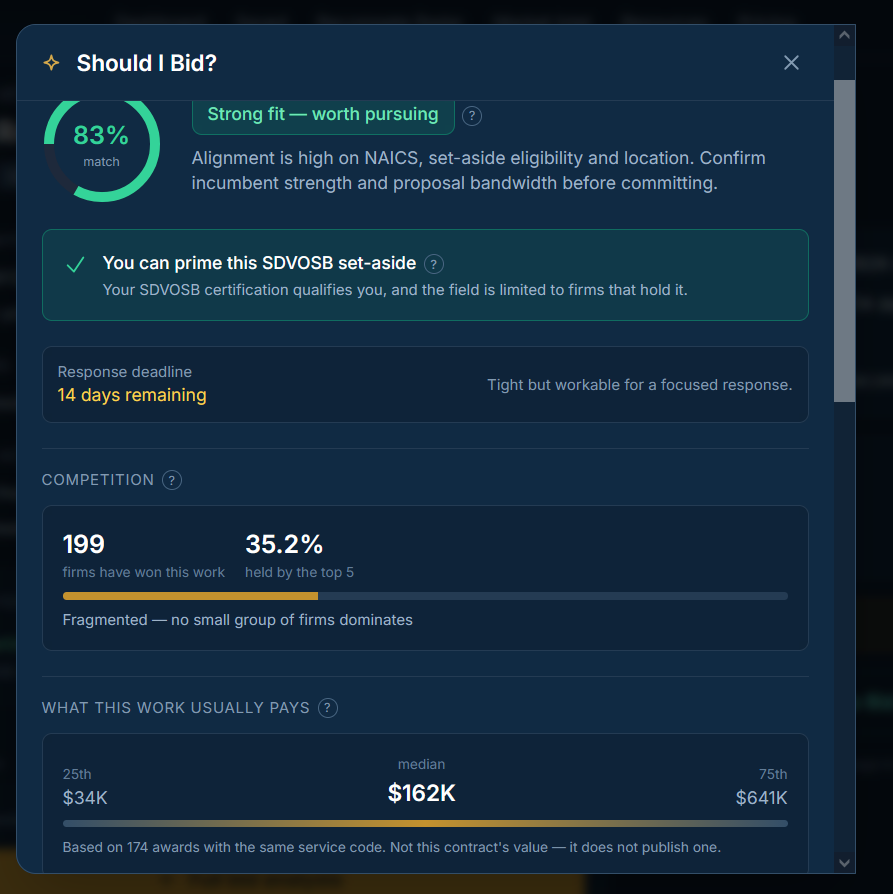
PathfinderBid boosts match scores when your certifications align with the set-aside. If you are not certified for a restricted set-aside, the score drops and suggested actions shift toward monitoring or teaming rather than a solo bid.
The categories, briefly
Small Business set-asides are the broadest: you qualify by meeting the size standard for the solicitation's NAICS code, which most small firms do without applying for anything. The socioeconomic programs are narrower and require a formal application with evidence behind it.
SDVOSB reserves work for service-disabled veteran-owned firms. HUBZone turns on where your principal office sits and where your employees live, which makes it the most location-dependent of the programs. WOSB and EDWOSB cover women-owned firms, with EDWOSB adding an economic disadvantage test. The 8(a) programme is a multi-year business development track for disadvantaged firms rather than a permanent status, so it has a clock on it.
Requirements and processing times change, and each programme is run by the agency that owns it. Confirm the current rules with the SBA rather than with a blog post — including this one — before building a plan around one.
When you do not hold the certification
A set-aside you cannot claim is not automatically a dead end. Where the rules allow it, an eligible firm can prime with you as a subcontractor, and certain joint venture arrangements let firms bid together on work neither could take alone. That is why a restricted set-aside is worth reading rather than skipping: the question is not only “can I win this”, but “who is going to win this, and should I be talking to them”.
It is also the argument for tracking who wins set-aside work in your codes. A firm that primes the same contract every three years is a potential partner long before it is a competitor.
Keep certifications current
Certifications expire and status can change. Keep documentation current and reflect updates in your profile so recommendations stay trustworthy.
An expired certification is worse than never having held one, because it usually surfaces at the point of award. Treat renewal dates the same way you treat your SAM registration renewal: in a calendar, months ahead, not in your memory.
Related reading
Stop reading SAM.gov by hand
PathfinderBid ranks every open federal solicitation against your company profile, so you see the ones worth your time instead of the ten thousand that are not. Free to try, no card required.
Get started free