
Where Do I Find My First Federal Contract?
Where to look, which opportunities are realistic to win first, and how to get on an agency's radar before the RFP.
Where the work is posted
SAM.gov is the authoritative place federal opportunities are published, and everything else — including this product — is ultimately reading from it. Start there, and treat any source that cannot tell you where its data came from with suspicion.
The difficulty is not access, it is volume. There are tens of thousands of open solicitations at any moment, the overwhelming majority of which have nothing to do with your business. Anything that helps you see only the relevant ones — filters, saved searches, a matching tool — is buying back the hours that would otherwise go into scrolling.
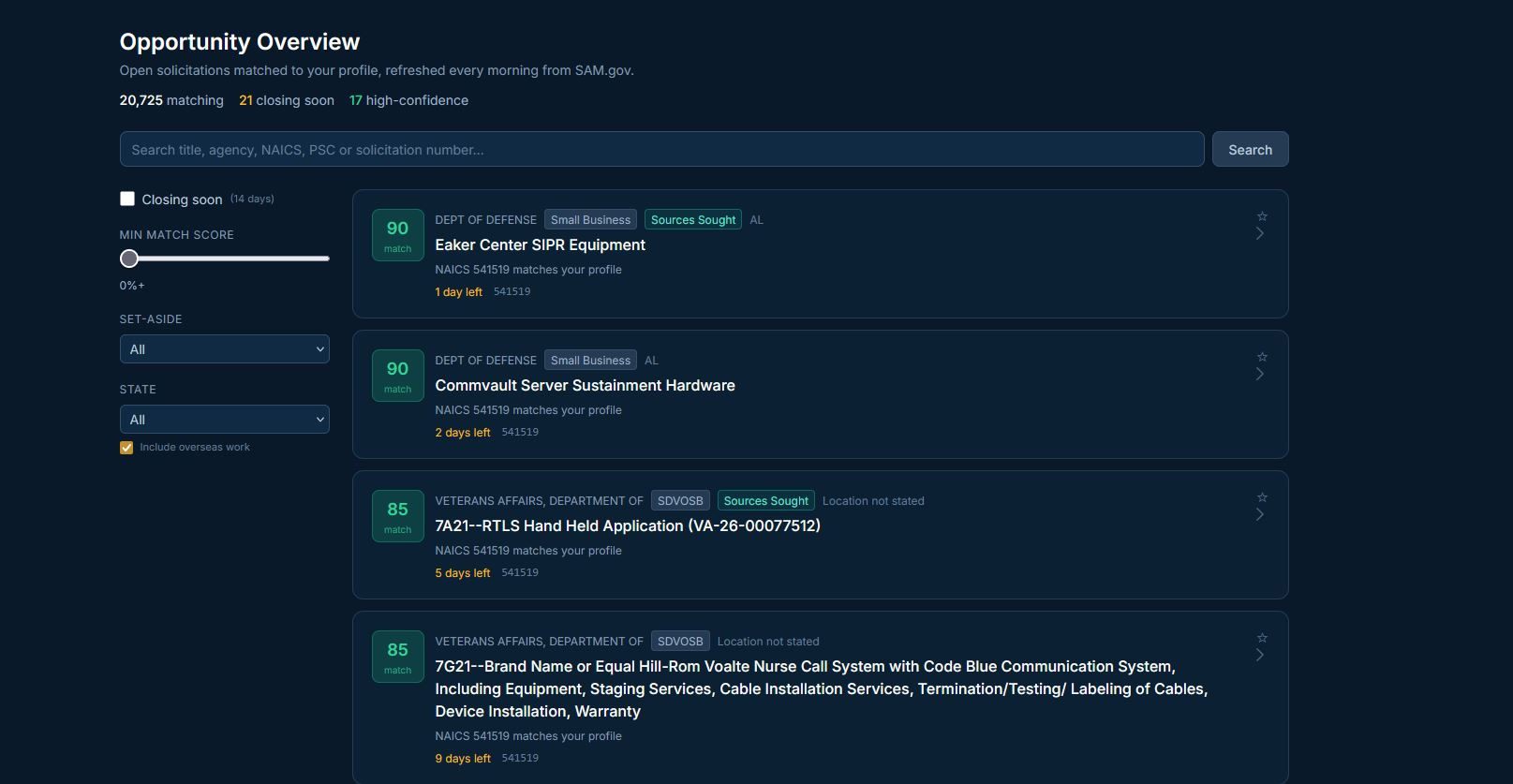
Your first win is probably small
Small-dollar purchases are the realistic entry point. Below a certain threshold, agencies can buy with far less process than a full negotiated procurement, which means a shorter response, fewer competitors, and a faster decision. These are the contracts that build the past performance record everything else depends on.
Set-aside work is the other lever. If you hold a certification, filtering to competitions reserved for it removes most of the field before you start. And subcontracting to a prime on a larger contract is a legitimate first step that gets you relevant experience without having to win the whole thing.
Get in before the RFP
By the time a solicitation is published, the requirement is written and the agency often has a good idea of who can do the work. The firms that win consistently were talking to that agency months earlier.
Sources Sought notices and Requests for Information are the formal invitation to do exactly that. They are the government asking who is out there and what is possible, and responding to one is low-cost, low-risk, and one of the few ways a small firm can influence whether a contract ends up set aside for businesses like theirs.
Expiring contracts are the other early signal. A contract ending in twelve months is a competition that has not been announced yet, and knowing who holds it now tells you who you would be bidding against.
Make it a habit, not a project
The firms that break in are not the ones who spend a frantic month on it and stop. They are the ones who look at a short, relevant list every week, pursue the two or three that genuinely fit, and let the rest go. Bidding on everything is how small teams burn out and win nothing.
Related reading
Stop reading SAM.gov by hand
PathfinderBid ranks every open federal solicitation against your company profile, so you see the ones worth your time instead of the ten thousand that are not. Free to try, no card required.
Get started free